

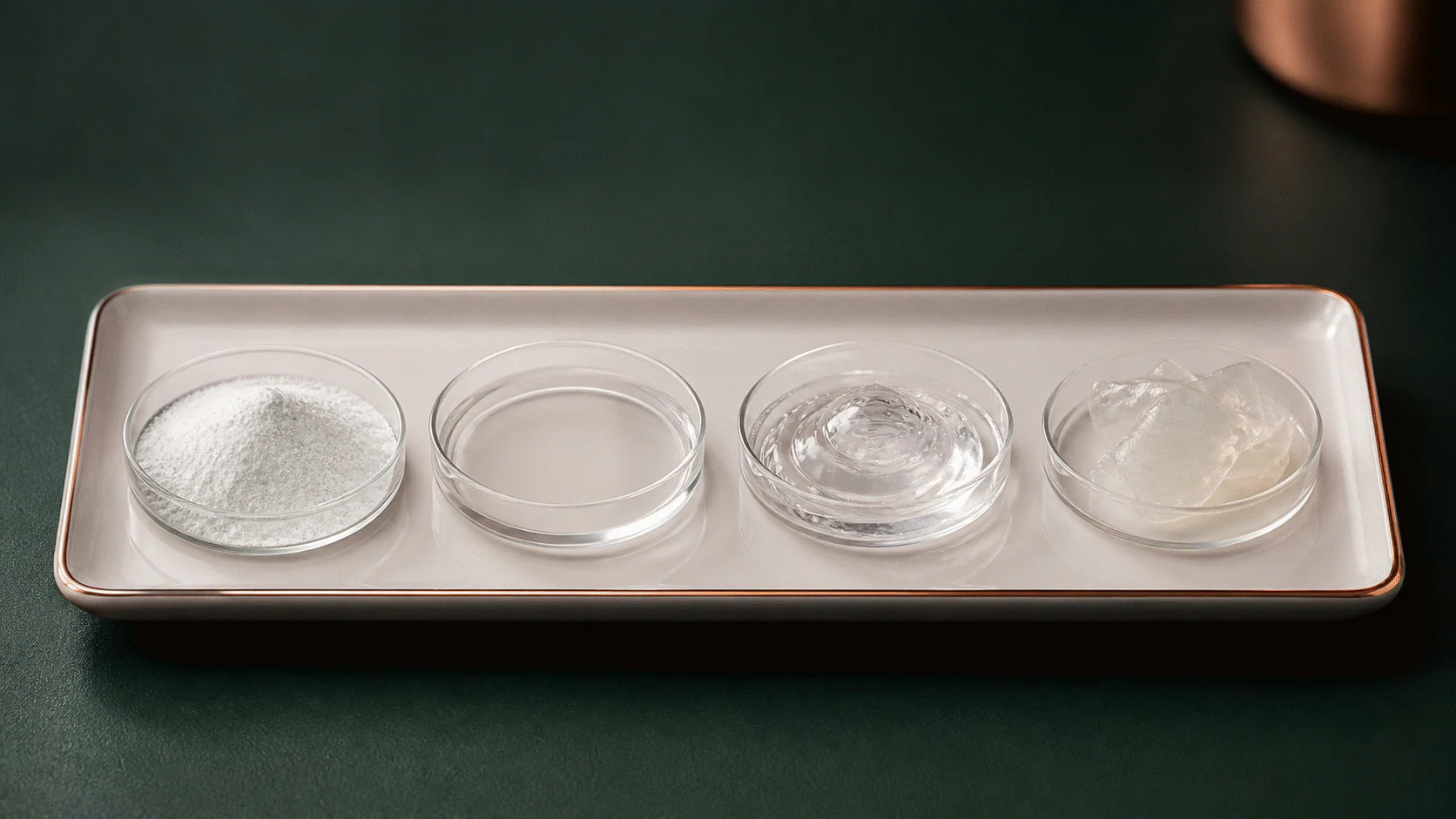
There are two versions of hyaluronic acid online: the clean marketing version and the untidy scientific one. The untidy version is more useful… because it keeps the conditions attached. Hyaluronic acid materials vary by molecular weight, modification, purity and use level. Topical benefits are largely hydration and surface-smoothing effects. The label rarely reveals enough to rank formulas by counting HA forms.
For this guide, the center of gravity is hyaluronic acid. Related ingredients such as sodium hyaluronate, hydrolyzed hyaluronic acid, glycerin matter only in context. Their identity, purity and use level influence the concept; solvents, polymers, emollients, preservation and packaging determine whether that concept survives contact with ordinary use.
Begin with the skin, not the slogan
The stratum corneum is thin, organized and chemically active. Corneocytes provide the structural units while extracellular lipids, natural moisturizing factors and water help control flexibility and water loss. A topical product encounters this changing surface before it encounters any pathway shown in a laboratory model.
A formula is applied to intact skin, not to a cell culture. Penetration depends on molecular properties, concentration, vehicle and barrier condition. Even demonstrated penetration does not automatically establish a visible or clinically meaningful outcome.
What the evidence can carry
Evidence for hyaluronic acid may include mechanistic experiments, ingredient studies and trials of complete formulas. Mechanistic work can explain why an idea deserves testing. Ingredient-level human research can narrow the uncertainty. The most direct support for a consumer claim comes from the finished product, used as directed, with an endpoint that matches the sentence being published.
Older research may remain chemically relevant, though repetition matters. When a modern claim rests on one small or supplier-sponsored study, the limitation belongs in the main discussion rather than hidden in a source list.
A vehicle-controlled trial is especially helpful because the base may provide much of the hydration or smoothing. Without that comparison, improvement from baseline cannot be assigned neatly to the highlighted active.
The formula decides whether the idea is usable
Materials grouped under sodium hyaluronate, hydrolyzed hyaluronic acid, glycerin do not arrive as abstract INCI names. They arrive in supplier blends with a grade, assay, solvent system, storage condition and recommended processing range. Active-basis calculation matters. So does the amount delivered by the package rather than the percentage printed in large type.
Sensory design affects adherence. A sticky humectant film, oily finish or pilling polymer can cause inconsistent use even when the ingredient rationale is sound. The most sophisticated formula still has to fit a real morning or evening.
Concentration is only one design variable. Raising it may alter viscosity, preservation, color, odor, irritation or solubility without delivering a proportionate improvement. Maximum strength is not a formulation endpoint.
A more defensible conclusion
The case for hyaluronic acid should be no larger than the evidence. Hydration, softness, comfort and smoother-looking texture are valuable cosmetic outcomes. Claims about deep remodeling, restored volume or a precise collagen increase require a very different demonstration. Interesting biology gets attention. It does not get to finish the sentence by itself.
Dermaste applies that rule to sodium hyaluronate, hydrolyzed hyaluronic acid, glycerin: select a measurable cosmetic target, document the material, build the simplest compatible vehicle, test the finished package and write the claim last. Quiet? Maybe. But it is a sturdier way to make skincare.
Details that change the interpretation
The central question in “Hyaluronic Acid Is a Family of Molecules, Not One Ingredient” is how far the concept can travel from biology to a finished cosmetic claim. For hyaluronic acid, the responsible path runs through material identity, a compatible vehicle, realistic exposure, stability and a measured endpoint. Each step can narrow the conclusion. That is not scientific pessimism. It is what keeps a useful surface benefit from being rewritten as structural transformation. Ingredients such as sodium hyaluronate, hydrolyzed hyaluronic acid, glycerin may contribute to a good formula, but their presence alone cannot establish the performance, tolerability or shelf life of the product a customer eventually uses.
For this hyaluronic acid question, supplier documentation is part of the evidence chain. Identity, assay, recommended pH, storage, microbial limits and composition determine whether research is relevant to the bench material.
For this hyaluronic acid question, routine adherence is an efficacy variable. A comfortable formula used consistently may deliver more value than a stronger product that repeatedly forces recovery days.
For this hyaluronic acid question, preservatives, antioxidants and chelators do different work. Tocopherol may slow oxidation in oils; it does not preserve a water-based serum against bacteria, yeast and mold.
For this hyaluronic acid question, finished-product testing should match final packaging. Pump output, nozzle evaporation, light exposure, leakage and material compatibility can alter the experience after filling.
For this hyaluronic acid question, skin tone deserves explicit attention in study populations and photography. Redness, pigmentation and surface contrast may present differently, while imaging systems can introduce limitations.
For this hyaluronic acid question, a restrained conclusion can still guide a purchase. Knowing that a product may improve surface hydration rather than rebuild anatomy is not disappointing information; it is a clearer expectation.
This article is educational and discusses cosmetics, not medical treatment. It does not diagnose a skin condition or replace individualized advice from a qualified healthcare professional.