

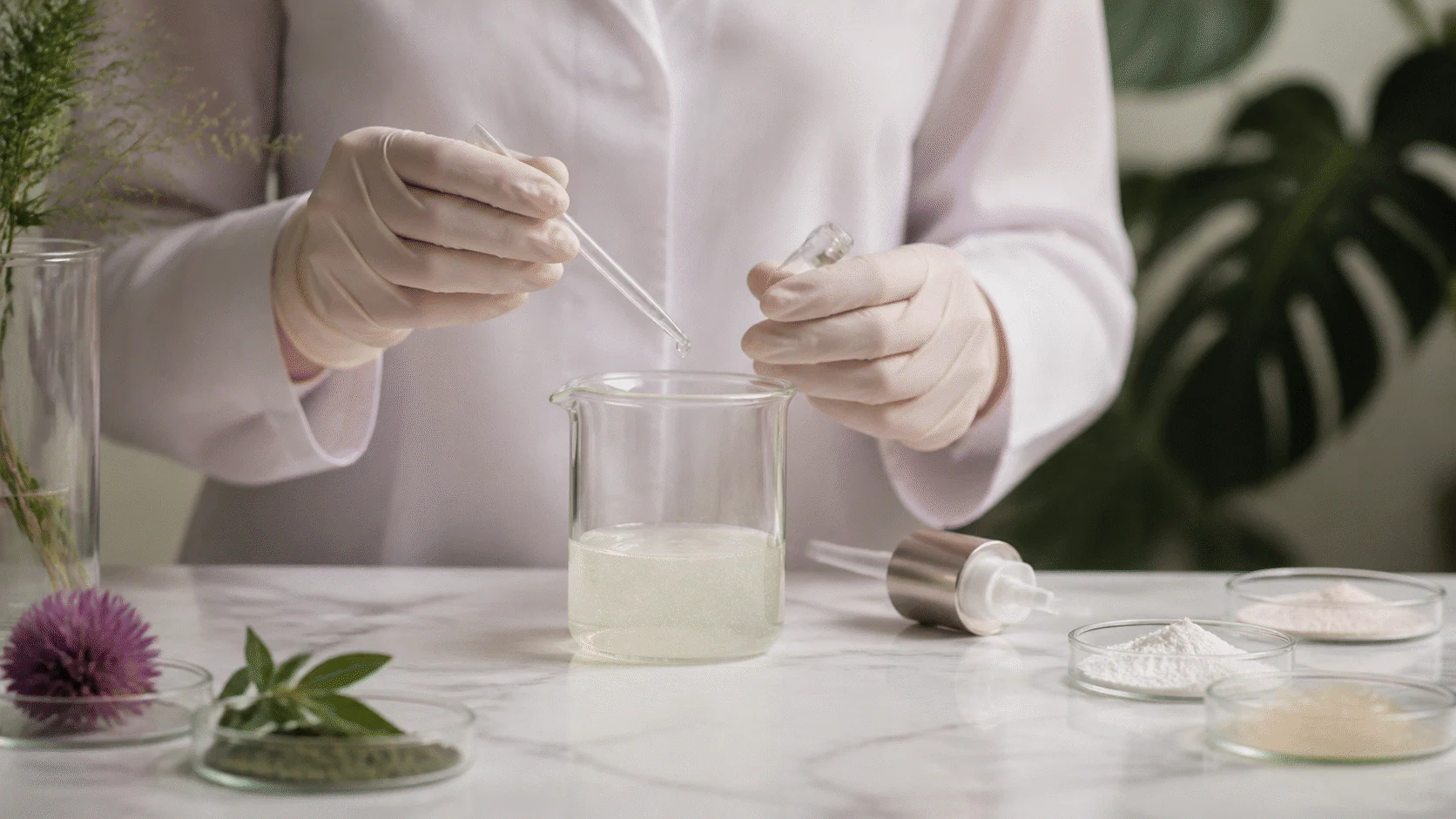
A good guide to preservation has to do more than define a molecule. It must connect chemistry to a realistic cosmetic outcome without skipping the formula in between. Water activity, pH, packaging, raw-material bioburden and consumer use affect microbial risk. Preservative performance is formula-specific and should be tested in the finished product rather than inferred from supplier brochures.
For this guide, the center of gravity is preservation. Related ingredients such as phenoxyethanol blends, organic acids, multifunctional materials matter only in context. Their identity, purity and use level influence the concept; solvents, polymers, emollients, preservation and packaging determine whether that concept survives contact with ordinary use.
Begin with the skin, not the slogan
A formula is applied to intact skin, not to a cell culture. Penetration depends on molecular properties, concentration, vehicle and barrier condition. Even demonstrated penetration does not automatically establish a visible or clinically meaningful outcome.
Skin condition is not fixed. Cleansing, ultraviolet exposure, humidity, age, medication, disease and the previous product layer can alter how a formula spreads or feels. This variability is one reason a plausible ingredient does not produce an identical result for every person.
What the evidence can carry
Evidence for preservation may include mechanistic experiments, ingredient studies and trials of complete formulas. Mechanistic work can explain why an idea deserves testing. Ingredient-level human research can narrow the uncertainty. The most direct support for a consumer claim comes from the finished product, used as directed, with an endpoint that matches the sentence being published.
Instrument readings need interpretation. A corneometer can support a hydration conclusion; elasticity devices and image analysis answer other questions. One measurement should not be translated into every favorable word available to marketing.
Instrument readings need interpretation. A corneometer can support a hydration conclusion; elasticity devices and image analysis answer other questions. One measurement should not be translated into every favorable word available to marketing.
The formula decides whether the idea is usable
Materials grouped under phenoxyethanol blends, organic acids, multifunctional materials do not arrive as abstract INCI names. They arrive in supplier blends with a grade, assay, solvent system, storage condition and recommended processing range. Active-basis calculation matters. So does the amount delivered by the package rather than the percentage printed in large type.
Concentration is only one design variable. Raising it may alter viscosity, preservation, color, odor, irritation or solubility without delivering a proportionate improvement. Maximum strength is not a formulation endpoint.
Preservation is part of product performance in any water-based formula. pH, raw-material bioburden, packaging and consumer handling affect microbial risk, which is why a supplier recommendation cannot replace challenge testing of the final system.
A more defensible conclusion
The case for preservation should be no larger than the evidence. Hydration, softness, comfort and smoother-looking texture are valuable cosmetic outcomes. Claims about deep remodeling, restored volume or a precise collagen increase require a very different demonstration. Interesting biology gets attention. It does not get to finish the sentence by itself.
Dermaste applies that rule to phenoxyethanol blends, organic acids, multifunctional materials: select a measurable cosmetic target, document the material, build the simplest compatible vehicle, test the finished package and write the claim last. Quiet? Maybe. But it is a sturdier way to make skincare.
Details that change the interpretation
The central question in “Why Water-Based Skincare Needs a Real Preservative System” is how far the concept can travel from biology to a finished cosmetic claim. For preservation, the responsible path runs through material identity, a compatible vehicle, realistic exposure, stability and a measured endpoint. Each step can narrow the conclusion. That is not scientific pessimism. It is what keeps a useful surface benefit from being rewritten as structural transformation. Ingredients such as phenoxyethanol blends, organic acids, multifunctional materials may contribute to a good formula, but their presence alone cannot establish the performance, tolerability or shelf life of the product a customer eventually uses.
For this preservation question, season and climate can change the baseline. A formula tested during a humid month may feel or perform differently in heated winter air, which is why context belongs beside averages.
For this preservation question, the one-percent line limits what ingredient order can reveal. Below that threshold, list position is a poor concentration calculator.
For this preservation question, skin tone deserves explicit attention in study populations and photography. Redness, pigmentation and surface contrast may present differently, while imaging systems can introduce limitations.
For this preservation question, consumer use is rarely as controlled as a protocol. People vary the amount, skip days, layer other products and store bottles in warm bathrooms. Development should anticipate that reality.
For this preservation question, supplier documentation is part of the evidence chain. Identity, assay, recommended pH, storage, microbial limits and composition determine whether research is relevant to the bench material.
For this preservation question, a product change can create downstream testing work. Altering a preservative, botanical extract, package or active concentration may affect stability and microbial control.
This article is educational and discusses cosmetics, not medical treatment. It does not diagnose a skin condition or replace individualized advice from a qualified healthcare professional.