

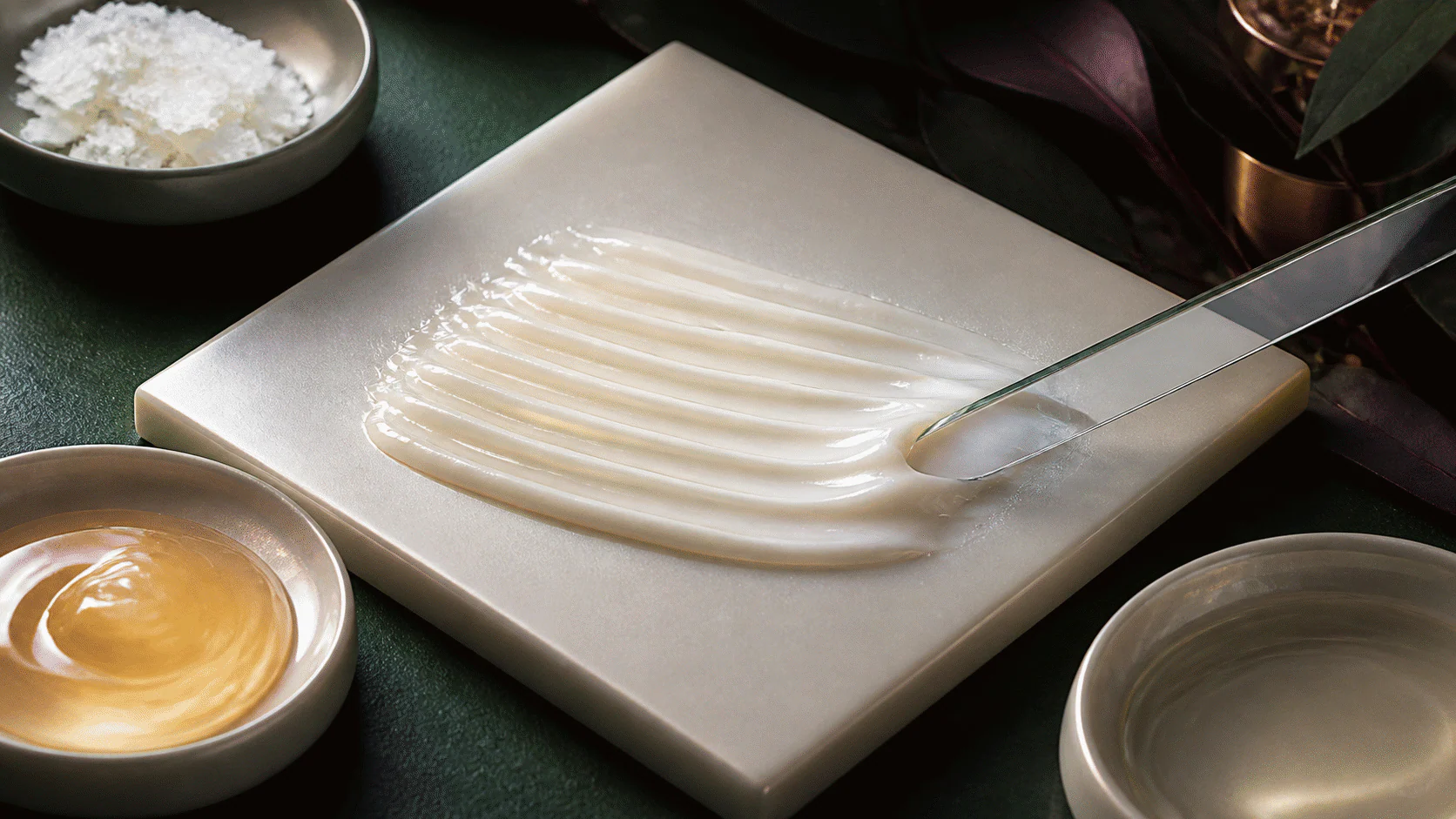
A good guide to ceramide nuance has to do more than define a molecule. It must connect chemistry to a realistic cosmetic outcome without skipping the formula in between. Ceramide performance depends on chemical class, dissolution, phase behavior and organization with cholesterol and free fatty acids. A ratio slogan cannot substitute for microscopy, process control and finished-product testing.
For this guide, the center of gravity is ceramide nuance. Related ingredients such as ceramides, cholesterol, free fatty acids matter only in context. Their identity, purity and use level influence the concept; solvents, polymers, emollients, preservation and packaging determine whether that concept survives contact with ordinary use.
Begin with the skin, not the slogan
Hydration can change the appearance of fine lines quickly because a better-hydrated outer layer scatters light and flexes differently. That is useful. It is not the same as restoring deep volume, rebuilding a fat compartment or proving new dermal collagen.
Midlife skin can become drier, less comfortable and less tolerant of routines that once seemed easy. A barrier-first response is reasonable, but cosmetics do not treat estrogen deficiency or perimenopause itself. The distinction protects both the reader and the integrity of the claim.
What the evidence can carry
Evidence for ceramide nuance may include mechanistic experiments, ingredient studies and trials of complete formulas. Mechanistic work can explain why an idea deserves testing. Ingredient-level human research can narrow the uncertainty. The most direct support for a consumer claim comes from the finished product, used as directed, with an endpoint that matches the sentence being published.
Older research may remain chemically relevant, though repetition matters. When a modern claim rests on one small or supplier-sponsored study, the limitation belongs in the main discussion rather than hidden in a source list.
Sample size, duration and population change confidence. Results from a short forearm study in healthy young adults should not be expanded casually to facial skin in adults experiencing persistent midlife dryness.
The formula decides whether the idea is usable
Materials grouped under ceramides, cholesterol, free fatty acids do not arrive as abstract INCI names. They arrive in supplier blends with a grade, assay, solvent system, storage condition and recommended processing range. Active-basis calculation matters. So does the amount delivered by the package rather than the percentage printed in large type.
Stability belongs beside efficacy. Heat, light, oxygen, metals and incompatible pH can change an active or the surrounding base. A formula that performs on mixing day but precipitates, oxidizes or drifts later has not completed development.
The ingredient declaration cannot show mixing order, heat history, supplier assay or degradation. It is useful for identifying materials and avoiding known sensitivities, not for reconstructing the formula from the outside.
A more defensible conclusion
The case for ceramide nuance should be no larger than the evidence. Hydration, softness, comfort and smoother-looking texture are valuable cosmetic outcomes. Claims about deep remodeling, restored volume or a precise collagen increase require a very different demonstration. Interesting biology gets attention. It does not get to finish the sentence by itself.
Dermaste applies that rule to ceramides, cholesterol, free fatty acids: select a measurable cosmetic target, document the material, build the simplest compatible vehicle, test the finished package and write the claim last. Quiet? Maybe. But it is a sturdier way to make skincare.
Details that change the interpretation
The central question in “Ceramide Creams Work Only When the Formulation Does” is how far the concept can travel from biology to a finished cosmetic claim. For ceramide nuance, the responsible path runs through material identity, a compatible vehicle, realistic exposure, stability and a measured endpoint. Each step can narrow the conclusion. That is not scientific pessimism. It is what keeps a useful surface benefit from being rewritten as structural transformation. Ingredients such as ceramides, cholesterol, free fatty acids may contribute to a good formula, but their presence alone cannot establish the performance, tolerability or shelf life of the product a customer eventually uses.
For this ceramide nuance question, a restrained conclusion can still guide a purchase. Knowing that a product may improve surface hydration rather than rebuild anatomy is not disappointing information; it is a clearer expectation.
For this ceramide nuance question, a claim should name an outcome the cited method can observe. Hydration, transepidermal water loss, participant-rated comfort and image-graded fine lines are different endpoints; improving one does not silently improve the others.
For this ceramide nuance question, the one-percent line limits what ingredient order can reveal. Below that threshold, list position is a poor concentration calculator.
For this ceramide nuance question, occlusion, humectancy and emollience solve related but different problems. Comfortable products often combine those functions instead of asking one celebrated ingredient to perform every job.
For this ceramide nuance question, sensitive skin is a useful consumer description rather than one uniform diagnosis. Triggers and tolerance vary, so conservative introduction is more defensible than a universal-safety promise.
For this ceramide nuance question, a clear formula is not necessarily a stable formula. Dissolved material can degrade without visible precipitation, while an opaque system may remain within its specifications.
This article is educational and discusses cosmetics, not medical treatment. It does not diagnose a skin condition or replace individualized advice from a qualified healthcare professional.