

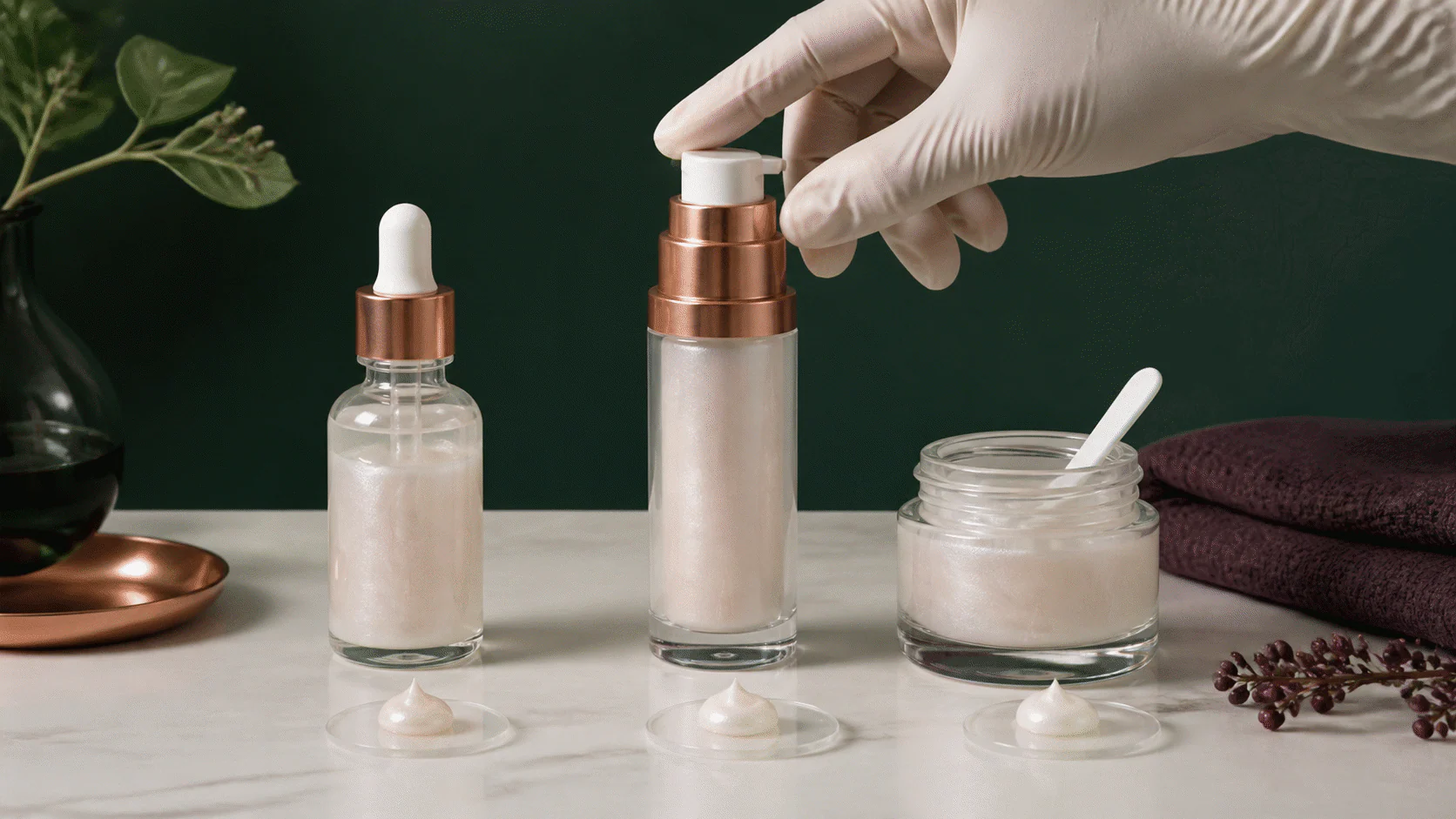
Droppers, Pumps and Jars: The Tradeoffs Nobody Mentions is fundamentally an evidence question. The label supplies an ingredient name; the paper supplies a material, dose, vehicle, population and endpoint. Those are not interchangeable. Packaging changes light, oxygen and microbial exposure as well as dose consistency. A good package must be compatible with the formula and realistic consumer handling.
Identify the evidence unit
The first task is to identify what “packaging” referred to in the research. It may be a purified molecule, a supplier blend, a group of related materials or a finished regimen containing treatment pumps, airless bottles, orifice reducers. Results belong to that tested unit. An INCI match on another bottle is not enough to transfer them intact.
A split-face study controls some person-to-person variation, though product migration, side preference and measurement technique can complicate interpretation. The design is clever; it is not automatically decisive.
Ex vivo skin retains some tissue architecture and can help examine deposition or penetration. It still lacks the complete circulation, behavior and repeated-use conditions of a living participant. Useful bridge, not final destination.
Read the endpoint literally
Investigator grading is valuable when scales and training are clear. Blinding, standardized photographs and agreement between graders determine how much confidence a small numerical change deserves.
Biomarkers may support a mechanism, though a changed marker is not necessarily a visible benefit. The missing bridge is sometimes exactly where advertising places its strongest verb.
Check the conditions around the number
For packaging, concentration without assay is incomplete. Supplier solutions can contain water, solvent, preservative and a fraction of the highlighted active. The study may also use a different grade or vehicle from the product being discussed. Those differences are not footnotes when stability or delivery is central to the mechanism.
Duration should match the proposed outcome. Immediate hydration and multiweek appearance changes do not share a timetable. Extending one into the other is an inference, not a result.
Check whether the primary endpoint was declared before analysis. A study measuring many outcomes can produce one favorable result by chance, especially when corrections and missing data are not explained.
What the paper lets us say
A fair conclusion about packaging preserves the material, vehicle, population, duration and endpoint. It may support plausibility, hydration, comfort or a measured appearance change. It does not automatically support deep delivery, restored tissue, treatment of a hormonal transition or performance by every formula containing treatment pumps, airless bottles, orifice reducers.
That sentence is longer than the marketing version. It is also the sentence the research can carry.
Details that change the interpretation
To evaluate “Droppers, Pumps and Jars: The Tradeoffs Nobody Mentions,” keep the study question intact. Research on packaging may test a pathway, a raw material, an instrument reading or a participant’s perception, and those results carry different weights. Concentration matters only with grade and active assay; a percentage without that context can compare unlike materials. The most defensible statement stays with the tested population, vehicle, duration and endpoint. Anything beyond that is an inference… sometimes a reasonable one, but still an inference that should be labeled rather than polished into certainty.
For this packaging question, finished-product testing should match final packaging. Pump output, nozzle evaporation, light exposure, leakage and material compatibility can alter the experience after filling.
For this packaging question, percentages deserve a denominator. Relative change can sound large when the absolute shift is small, and an average does not show how widely individual responses were distributed.
For this packaging question, supplier documentation is part of the evidence chain. Identity, assay, recommended pH, storage, microbial limits and composition determine whether research is relevant to the bench material.
For this packaging question, cosmetic and drug status turns on intended use, including claims. A sentence about treating disease or changing body structure does not become cosmetic because it appears beside moisturizers.
For this packaging question, a claim should name an outcome the cited method can observe. Hydration, transepidermal water loss, participant-rated comfort and image-graded fine lines are different endpoints; improving one does not silently improve the others.
For this packaging question, the absence of stinging does not prove efficacy, and stinging does not prove activity. Sensation can arise from pH, solvents, fragrance, barrier condition or several ingredients together.
This article is educational and discusses cosmetics, not medical treatment. It does not diagnose a skin condition or replace individualized advice from a qualified healthcare professional.